- AJ Products UK
- Inspiration
- Tips & trends
- Tips for better warehouse safety
Tips for better warehouse safety
Think about the floor
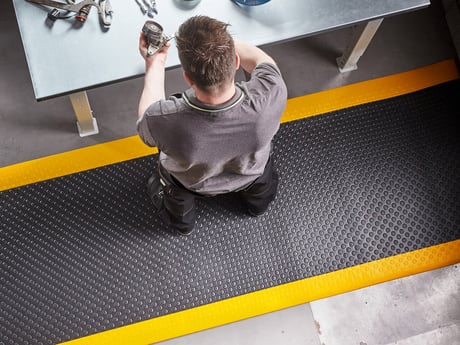
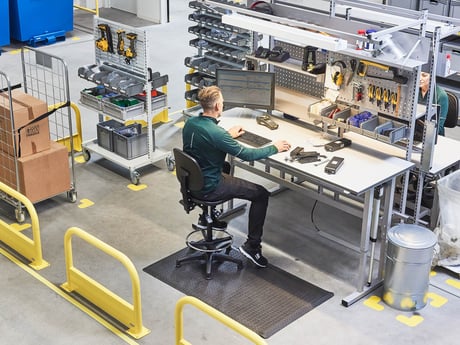
The floor is more important than you might think. Generally, warehouses have hard floors, which are ideal for use with forklift trucks. However, for jobs where workers stand for long hours, such as packing or operating machinery, a softer floor is better as it will help reduce strain on the feet, legs and back. This can be easily achieved by placing anti-fatigue mats on the floor.
It’s also important to have a completely level floor, but if that is not possible a ramp is better than steps. Make sure that you fix any potholes, cracks or uneven joins in the floor because irregularities will increase the risk of accidents.
Wet floors are another frequent risk from cleaning, weather at open doorways or machinery leaks, so non-slip matting in high-traffic or high-risk zones is worth the investment.
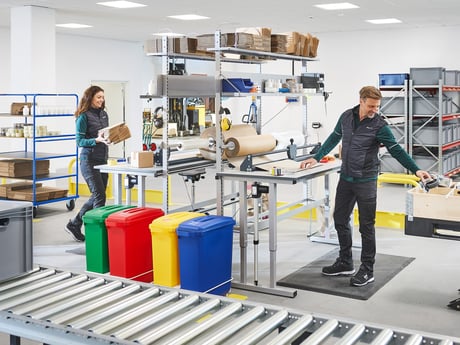
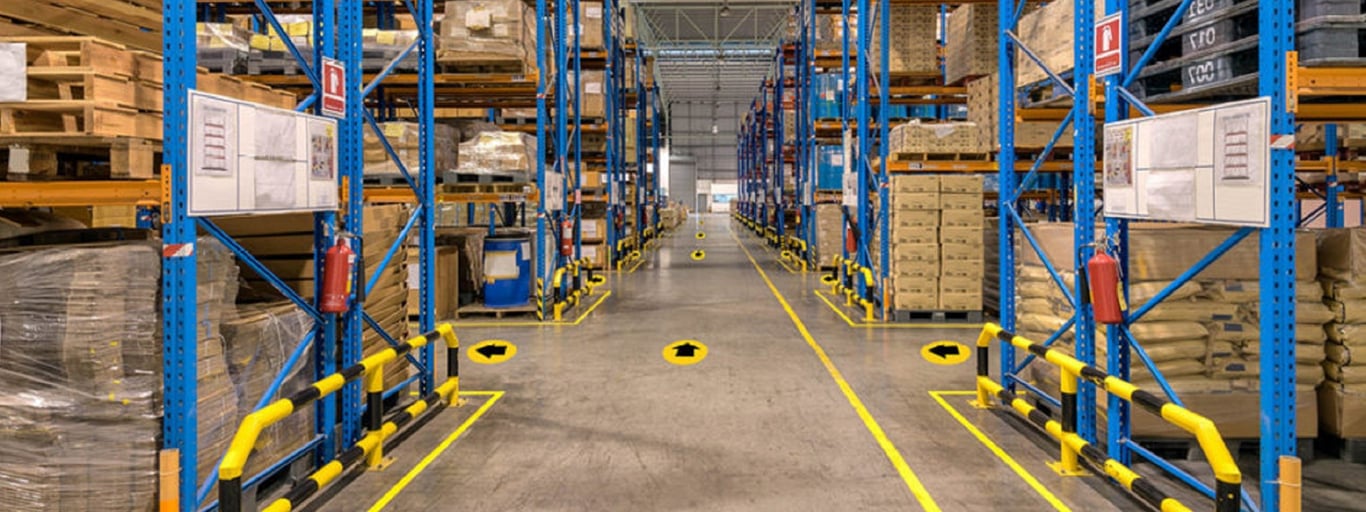
It's also worth thinking about marking pedestrian routes or hazard zones, colour-coding your flooring consistently (for example, yellow for walkways, red for hazard areas) makes the layout easier to read at a glance for staff and visitors alike.
Look around the corner
Any warehouse that operates forklift trucks and other industrial vehicles will be well aware of the potential dangers they pose. It is important to have a clear line of sight to prevent collisions with others vehicle or with staff on foot. Mirrors positioned at the end of pallet racking aisles or in other blind spots, give drivers a warning of what's waiting around the corner. Even at limited speeds, this warning can prove to be extremely valuable from a safety point of view.
Driver training and certification matters just as much as the equipment itself. Forklift operators should hold up-to-date certification, and speed limits should be clearly set and enforced across the site, with lower limits in tighter aisles or high-footfall areas.
Separating people from vehicle traffic is one of the most effective ways to reduce risk in large logistics spaces, indoors and outdoors alike. Where possible, use a physical barrier (safety barriers, guardrail or bollards) to keep pedestrian routes fully separated from vehicle paths. Where a physical barrier isn't practical, painted floor lines, arrows and floor signage can mark out transport routes, risk zones and escape routes clearly.
It's also worth having an easy-to-deploy barrier system on hand for temporary situations: cordoning off a hazard, a spill, or an area under repair. Belt barriers or chain posts are a quick, portable way to close off a zone and just as quick to pack away once it's clear.
Racking & storage safety
Pallet racking carries some of the highest‑consequence risks in a warehouse, a collapse or overload doesn’t just damage stock, it puts people nearby at serious risk. A regular inspection schedule is the first line of defence: racking should be checked routinely for bent uprights, damaged beams, missing safety clips or dislodged pallets.
In line with BS EN 15635 (the UK-adopted standard for the use and maintenance of steel storage systems), many sites run a three‑tier approach: immediate reporting of impacts by all staff, frequent visual checks by a trained Person Responsible for Racking Safety (PRRS/PRSES), and a documented expert inspection at least every 12 months.
Every racking bay should be clearly signed with its safe load capacity, and staff should know never to exceed it. Damaged racking should be taken out of use immediately, a simple tagging system (a bright “do not use” tag or barrier tape) makes this easy to enforce on the floor.
It’s also worth building racking safety into wider site routines: include it in your regular health and safety walkarounds, keep a written log of inspections and repairs, and make sure whoever is responsible for reporting damage knows exactly who to flag it to.
PPE & manual handling
Personal protective equipment is the baseline for warehouse safety, but it only works if it's the right kit for the task and staff actually wear it consistently. High-visibility clothing is essential anywhere vehicles operate, along with safety footwear to protect against dropped loads and uneven flooring. Depending on the tasks involved, gloves, hearing protection or hard hats may also be needed.
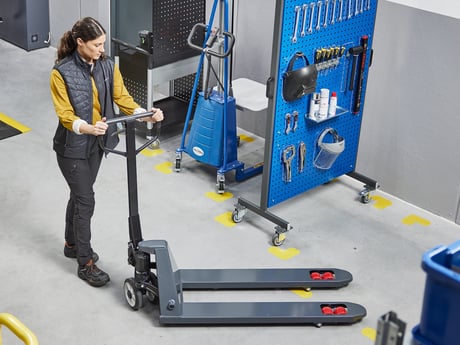
Manual handling is one of the most common sources of injury in warehouse environments, and often one of the most preventable. Staff should be trained in safe lifting technique as standard, but training alone isn't always enough, wherever possible, the better fix is removing the need to lift manually at all. Trolleys, pallet trucks and lifting equipment reduce strain significantly and are worth the investment anywhere heavy or repetitive lifting is part of the job.
Practice and prepare for evacuation
We can’t talk about personal safety and not mention evacuation of the workforce in the event of an emergency. It is essential that all personnel are given comprehensive training so that they know what to do in such circumstances. You should carry out frequent evacuation drills to ensure the knowledge stays fresh in everyone’s minds. Remember that you are also legally required to ensure that escape routes are clearly marked, easy to access, wide enough and free of obstacles.
- Racking should be visually checked as part of regular site walkarounds, with a more thorough formal inspection carried out periodically by a trained assessor. Any damage found between inspections like bent uprights, missing clips or dislodged pallets, should be reported and isolated immediately rather than left until the next scheduled check.
- There's no single mandatory colour scheme, but consistency across your site matters most. A common approach is yellow for pedestrian walkways and general demarcation, with red or red-and-white used for hazard zones. Whatever convention you choose, apply it consistently so staff and visitors can read the layout at a glance.
- It depends on the tasks carried out on site, but common requirements include high-visibility clothing anywhere vehicles operate and safety footwear throughout. Gloves, hearing protection or hard hats may also be needed depending on the specific hazards involved. A task-by-task risk assessment is the best way to confirm exactly what's required.
Evacuation drills should be run regularly, not just as part of new starter induction, so that procedures stay familiar to everyone on site. The frequency depends on staff turnover, site layout and risk level, but a routine schedule (rather than an ad hoc one) is what keeps a drill effective.